Wednesday, September 15, 2010

September Bloom Day: The End of the Summer Garden

It's time for another Garden Blogger's Bloom Day, the brainchild of Carol at May Dreams Gardens.  This is a great way to record what is blooming each month, especially for those of us who are rather lax about keeping a garden journal. 


September is definitely a slow time in my garden, as I realize I haven't planned enough for fall color.  Add to that the heat and drought-like conditions we've had the past two and a half months, making for a less than pretty picture.  Still as I walked around on Sunday, I did find some new blooms for this month, including the mounding  NOID aster above  in the front garden.


Much showier, yet hard to photograph is the native aster in the butterfly garden. When it looked stressed earlier this summer,  I cut it back hard, and it seems to have appreciated the drastic haircut.


The butterfly garden is definitely a place where only the strong will survive, and the aster seems to be holding its own among the native goldenrod and obedient plants.


Speaking of a strong survivor, I know I've shown these 'Cosmic Orange' cosmos countless times before, but you've got to love a plant that keeps on going on summer long.  Have I mentioned these are 4 to 6 feet tall? And no worries about staking--these have been buffeted by strong winds and still stand tall.


One of the few annuals that survived the drought in the butterfly garden this year are these four o'clocks.  'Broken Colors,' seeds from Renee's Garden, were directly sown in the soil.


As you can see, the blooms come in a variety of hues, from pastel to hot colors. I'm going to try to collect some seeds from these, but I won't mind one bit if they reseed themselves as well.


One of my favorite plants in the fall is sedum, a favorite, too, of the butterflies and bees.  We all like to show our gardens in the best possible light, and this close-up does show off the pretty pink and white early florets of 'Autumn Joy.'


 But for once, I'm going to show you the whole not-so-pretty picture.  This sedum in the roadside garden looks as though an animal decided to take a nap right in the middle of it, but I suspect the plant simply flopped over.  As unattractive as this is, at least the plant looks healthy, which is more than I can say for the same sedum in gardens nearer the house.  All of those look as though they're ready to die, and I've yet to figure out why.


At the other end of the roadside garden, the area is dominated by the dried seedheads of coneflowers.  Thank goodness for the 'Victoria Blue' salvia which add some much-needed color to an otherwise brown and green landscape.


Also in the roadside garden is my one and only zinnia that germinated this year.  It's pretty lonely, so I hope next year's weather is not so extreme, and I can have the usual crowd of zinnias once again.


I do have some smaller zinnias in the lilybed, but these were bargain seedlings purchased at a garden center, so they don't count to me.  I like the tall ones that come in a range of colors and usually bloom in August, just when other blooms are beginning to wane.


My containers are looking pretty ratty, too.  The petunias and callibrachoas have pretty much bit the dust, the result of  less-than-diligent watering, no doubt.  In some cases, a tough plant has taken over to compensate in the pot, like this annual purple fountain grass.  Photographing grasses is a tricky task that I haven't mastered yet, so I hope these few plumes give you an idea of the beauty of this grass that even looks good covered in snow.


The basket of double impatiens is still looking good, however, probably because it has escaped the wrath of the sun all summer in a shady spot on the front porch.


And while the lovely 'Creme Brulee' petunias in this pot finally withered and gave up last week, this Ipomoea 'Sweet Georgia' has taken over and produced some blooms. Joy showed some blooms on one of her sweet potato vines one day, but this is the first time I've ever had blooms on any of mine.


That's it for new blooms in my garden, but a few re-bloomers are worth noting.  Now that the Japanese beetle onslaught has come to an end, the Knockout roses are blooming their heads off.  I can't say enough about these roses--they bloom from early spring until frost and are perfect for lazy gardeners  gardeners like me who don't want to fuss with hybrid teas.


The new 'Radsunny' Knockouts in the lilybed are also resurging.  I love yellow roses, although these, I've discovered, turn white as they fade.


The much-maligned Stella d'Oro daylilies are also putting out a few new blooms even though I forgot to fertilize them as I recommended earlier this summer.


And even though coneflower season is over, a few late volunteer seedlings have put out a few blooms.


And finally I can't end this GBBD post without including one more photo of my favorite end-of-summer blooms--the 'Limelight' hydrangea. 


It's been a challenging summer for gardeners, and I, for one, am glad to have the cooler temperatures and see signs of fall on its way. Although the garden is coming to an end, the abundant crabapples on this white flowering crab tell me that by next GBBD at least there will be lots of berries and colorful leaves to share.

I'm spending a few days with some special visitors here this week, so I probably won't have time to get around and visit everyone until later this week.  But I will catch up on reading all your posts then!  In the meantime, be sure to visit our hostess Carol and see what is blooming all over the rest of the world.

Wednesday, September 8, 2010

Preparing For Some Special Guests

It's a busy, busy time here at the Prairie as I prepare to welcome some special visitors next week.  One I have met, one I haven't met in person before, but I feel as though I've known her for ages.  I look at my house with critical eyes--why haven't I replaced all this carpeting by now?  Can I get the windows washed and the clutter put away before they come?  How much cat and dog hair will Toby and Sophie shed after I've vacuumed??


And then there's the garden.  They are gardeners, too, so I know we will be walking around the garden,  inspecting it much more closely than my house.   I've been trimming and weeding and even some deadheading, but it's a never-ending cycle.  It's been such a hot and dry summer that the garden is looking pretty sad.  The native asters and some remaining goldenrod are the only new blooms standing in the butterfly garden that otherwise is going to seed.


  Too late, I realize that I've focused too much on spring and summer blooms in my garden.  I hope my visitors find the seedheads of coneflowers interesting, because the big stand of blooms is long gone.


I wonder what they will be expecting; will they be disappointed?  I always warn visitors ahead of time that my garden is small.  Don't expect drifts of anything, unless an eight-foot border of lantana counts as a drift.


These Monarda blooms are not from my garden, but I do have plenty of bees, which should delight one of my visitors especially.

Perhaps the bees and the butterflies will make up for the lack of blooms . . .


. . . and distract them from seeing the weeds:)


It won't take us long to walk around my garden, so there should be plenty of time to sit and chat.  I know we'll find so much to talk about; we might sit on my front porch,  if Tarzan and Marmalade are willing to share their seat.


And from this vantage point they might get to see my hummingbirds up close and personal instead of the blurry photos that are all I seem to be able to get.  I just hope the hummers' migration doesn't start too soon.


Fortunately, my visitors are all dog lovers, which is a good thing because Sophie is excited about their arrival, too.  She loves visitors!

Although we received two inches of rain last week, we need much more.  But not next week!  I am hoping for sunny skies to enjoy visiting gardens with my special visitors, who I'll tell you all about later next week.  I know we're going to have a wonderful time, and I can't wait!

Wednesday, September 1, 2010

Book Review: A Shakespeare Thriller for Muse Day

 Unidentified weed on our farm

Last week's Wildflower Wednesday posts inspired me to reflect for a time on our perspectives of the world of plants.  Many participants echoed the sentiment that "One man's weed is another man's wildflower."  How true that is, not only from an aesthetic point of view, but for other reasons as well. If you do a little research on native plants, it is surprising how many commonly overlooked plants were once prized  by Native Americans for their medicinal uses.  Even today, medical researchers are finding hidden healing properties in various plants. Often times, one part of a plant may contain a miracle cure or be a tasty edible, while another part of the same plant is highly toxic. All this reminds me of a passage from Romeo and Juliet read and discussed every year in my freshman English classes:

Many for many virtues excellent,
None but for some, and yet all different.
O, mickle is the powerful grace that lies
In herbs, plants, stones, and their true qualities:
For naught so vile that on the earth doth live,
But to the earth some special good doth give;
Nor aught so good, but, strain'd from that fair use,
Revolts from true birth, stumbling on abuse:
Virtue itself turns vice, being misapplied;
And vice sometime's by action dignified.
Within the infant rind of this small flower
Poison hath residence, and medicine power:
For this, being smelt, with part cheers each part;
Being tasted, slays all sense with the heart.
Two such opposed kings encamp them still
In man as well as herbs,--grace and rude will;
And where the worser is predominant,
Full soon the canker death eats up that plant.

Leave it to good old Will to express so eloquently the myriad properties of the plant kingdom and their similarities to the nature of Man.

Persicaria, aka "smartweed"--still a weed to me!

Speaking of Shakespeare, after a three-month absence, I am joining in again in the monthly meetings of the Book Review Club, hosted the first Wednesday of every month by Barrie Summy.  It's not that I haven't read anything this summer--actually, this hot summer found me spending many afternoons indoors with the A/C and a good book.  But of all the books I read this summer, only one was new enough and worthy of reviewing here:  Interred With Their Bones by Jennifer Lee Carrell.

Shakespearean scholar Kate Stanley has left the world of academia to follow her dream as a director in the theatre. During the dress rehearsal of Hamlet at the newly reconstructed Globe Theatre in London, Kate's mentor Roz gives her a box wrapped in gold tissue and ribbon, with the instructions "If you open it, you must follow where it leads." Later that night, a suspicious fire engulfs the Globe, and Roz's body is found--not a victim of the fire, but of murder.

Shakespeare garden at the Chicago Garden Show
In shock and with an eerie feeling that she is being followed, Kate feels compelled to open the box given to her by Roz.  Inside she finds a cryptic message that eventually leads her on a dangerous chase to unlock a mystery that could rock the literary world. 

"Plot twists worthy of The DaVinci Code" states the reviewer from Publishers' Weekly on the book's cover, and indeed there are similarities to that blockbuster.  Like Robert Langdon, Kate Stanley is on a quest to find a legendary artifact, in this case a lost manuscript of Shakespeare, and like Langdon, she is an expert on her subject, sharing all kinds of Shakespearean esoterica along the way.  Her journey takes her across the country and across the Atlantic along with the mysterious Ben who appears by her side one day as her protector, and Sir Henry, a distinguished Shakespearean actor.  She is not alone in her pursuit as destruction and deaths follow her travels.

Like the Da Vinci Code, the novel is fast-paced as one answer only leads to another clue to be unraveled, and Kate begins to wonder who she can trust.

But this is not another Da Vinci clone; Interred With Their Bones is an intriguing thriller that stands on its own merit.  Mystery fans and anyone who enjoys Shakespeare will find this a great read, whether on a warm beach this summer or later on a cold winter's night. Thanks so much to Cindy of My Corner of Katy for recommending this book to me!

For other reviews of some great books, be sure to check out this month's meeting of the Book Review Club hosted by Barrie Summy.

And thanks once again to Carolyn Gail for hosting another Garden Muse Day, held the first of every month.

Monday, August 30, 2010

Study on Seed Starting Finally Completed!

A month ago or more I received an e-mail from a blogger I'd never visited before wondering about the seed starting project I discussed last spring and whether I had published my findings.  Oh for shame!  What kind of researcher proposes a project and even contemplates government funding for it, but then never publishes her results?  Although I rejected the idea of asking for a public handout to support my research, I did want to share my findings with anyone interested for the general betterment of gardens everywhere.

If you missed my initial research proposal on starting seeds indoors, you can click here.  Or if you're short on time, I'll give you a brief overview.  After two years of less than successful results with indoor seed starting, I decided to document the various factors involved, in an attempt to determine how one might achieve more success in growing seedlings indoors.  Light, temperature, and potting mediums were all variables that were studied.  Unfortunately, by the time I had planted all my seeds and moved seed cells around to share light, the control groups were so mixed up that instead of Groups A, B, and C, I wound up with groups that could be more accurately called AC/DC or CRAP.   As if that wasn't bad enough, I used pieces of cardstock as labels which disintegrated after several waterings, and soon I wasn't sure if I was growing salvia or gaillardias.  (My son saw my set-up of trays under shop lights in the basement one day and was worried Mom was growing something else:) )

The end results were better than in past years, but still rather disappointing.  Some seeds didn't germinate, and of the many that did, some didn't seem to grow past a certain point.  But most discouraging was the fact that many of the seedlings that did survive eventually grew leggy and didn't survive transplanting.  If anyone has suggestions on tips for the final stage of seedlings, I would appreciate it.  One bit of good news--no damp rot this year!


The main reason I have waited so long to share my findings with you is because I wanted to see how the plants fared after some time in the garden.  So here are a few of my successes;


The tomato plants did very well, but I was disappointed that the seeds from 'Sugary Grape' did not germinate at all.  But wait--I do have grape tomatoes!  Not sure what happened here, but all the tomato seedlings looked alike to me.


'Victoria Blue' salvia, a favorite annual of mine, grew well with its start on the heatmat.  But a funny thing happened when I planted it--can you see it at the back of this planter?  No, and it's not just because it's a bad photo--the tall stem whose bloom is cut off in the photo is not salvia, but Verbena bonariensis!  Planted in several pots instead of the missing salvia, it adds a little more vertical interest than I had intended.


And those Zahara zinnias I drooled over in the catalogs last spring--'Starlight Rose'--somehow turned into Profusion Yellows!   The butterflies don't seem to care, but I'm still wondering what became of the 'Starlight Roses.' Obviously, proper labelling is one variable that needs to be corrected if this project is to be attempted again.

But the worse case of incorrect labelling has to be the seedlings I shared with friend Beckie.  I was so proud of the gray-headed coneflower seedlings I started and shared a few with Beckie, informing her that this native flower was so quick to germinate and surely would be easy to grow.  I began to have my doubts, though, a few weeks later when I noticed some similar seedlings beginning to grow in my vegetable garden.  Yes, you guessed it---the coneflower seedlings were actually . . .


Kohlrabi!

Now, seriously, the kohlrabi, 'Crispy Colors Duo'  from Renee's Garden and the gray-headed coneflowers were a last-minute planting indoors, and I know I labelled them right.  I'm beginning to believe Carol's garden fairies have been visiting my house . . .


Seriously (or maybe not), here are some of the things I learned from this year's seed starting project:

Just a portion of one day's tomato harvest this past week.

1. Tomatoes are very easy to grow from seed.  That being said, I probably won't start any tomatoes again next year, unless there's an heirloom variety I really want to try.  I'm just too cheap frugal a person to make myself throw out excess seedlings, and I don't want 20+ tomatoes of the same variety again next year.

2. The newspaper pots inspired by Fairegarden seemed just the right size and worked quite well, especially since growing seedlings could stay in them until time for transplanting.  Since the investment has already been made in the wooden pot maker, this means no money needs to be expended on peat pots or trays with cells next year.  And I'll be recycling besides!

3.  Seeds started indoors need daily attention.  If you can't find the time for a few minutes of misting or monitoring the seedlings every day, then don't even bother planting them.  All it takes is one day or two for a seedling to dry out, and then it's a goner.

4. Related to #3, do not plan to take a one-week trip to Portland, Oregon to visit your youngest daughter and leave seedling care up to Mr. I-Don't-Care-About-Flowers-Just-Tomatoes.  To be fair, he did try, I think, but I'm not sure he remembered them everyday.

5.  And related to #4,  do not assume because the month of April was unusually warm that May will be the same and put all your seedlings outside to make watering easier for Mr. IDCAFJT.  Naturally, we had a couple nights of frost while I was away, and although I had placed a blanket within easy reach on the porch which Mr. I did use, some of the seedlings still died, though whether from frostbite or suffocation, I'm not sure.

6. Finally, LABEL, LABEL, LABEL all seeds with permanent markers!  Heavy paper or cardboard just doesn't cut it after being watered several times.  I'm still looking for something small and more durable next year; any ideas would be appreciated.  I'm thinking of using toothpicks with duct tape, kind of like little flags--what do you think?


At last!  I hate to have unfinished projects lying around, so it's such a relief to finally have completed this one.  Although completion of this project was unavoidably delayed, at least you can be reassured that none of your hard-earned tax dollars were used to fund this study.  However, I am thinking about looking for a little part-time work--do you think I can put research project coordinator on my resume??

Wednesday, August 25, 2010

Three Wildflowers for Wednesday and Thursday


It's time for Wildflower Wednesday once again, a monthly discussion of wildflowers started by native enthusiast Gail at Clay and Limestone.  Two years ago I couldn't tell the difference between a cup plant and a compass plant, so it has been an enlightening and enjoyable experience to learn about wildflowers from Gail's and now others' posts.  I have become more aware and curious about the plants growing freely around me and have begun to do some research on my own to learn more about them.

I didn't have to look far, though, to find three choices for today's posts--all of these are blooming in my garden right now:


This is the first year for blooms on my Physostegia virginiana, otherwise known as 'False Dragonhead' or 'Obedient Plant.'  A member of the mint family, Obedient Plant has single-branched stems that can grow up to 4 feet tall. The flowers are tightly clustered in long spikes at the top of the stems.  Blooms are usually rosy pink or purple, especially in cultivated forms, while the native wild forms are usually white with some pink or purple tints.  The name 'Obedient Plant' comes from the flowers' tendency to stay in the same position, even if moved to the side.  'Obedient Plant' is pollinated by bees and visited by other insects and hummingbirds.


Neither of my sources* mentioned that this is an aggressive spreader, other than in moist sites, but I can attest to the fact that it does spread rather easily.  Last year I planted one lone plant, purchased from the local Prairie Plant Society.  Before it grew much past two feet tall, a rambunctious Sophie knocked it over and  broke off the stem.  I thought that would be the end of it, but apparently it had had time to set some seed because this year I have a whole cluster of Obedient Plants at the back of my Butterfly Garden, as seen in the top photo.


Also blooming at the back of the Butterfly Garden right now--and behind the barn and the sheds, next to my compost pile, and pretty much anyplace with undisturbed soil--is the native Goldenrod.  This is not your neat, dwarf cultivar, but  probably  Solidago Canadensis, or Canada Goldenrod, a native perennial common throughout Illinois, despite its Canadian name.  This wildflower can grow up to 7 ' tall; its hairy stems are topped with flower heads arranged in a pyramidal cluster on the upper side of the branches.  Blooms last for about three weeks from late summer to early fall.


Fortunately, more and more of the public is now aware that Goldenrod is not the allergy culprit it was once accused of being.  In fact, Native Americans used to make a tea from it to treat kidney problems and chewed the crushed flowers to treat sore throats.  A wide variety of insects are attracted to this plant, including species of wasps and flies who play an important role in insect control.  Several species of birds as well as deer and rabbits are also attracted to Goldenrod. I found this out for myself while taking pictures for my last post--each plant was full of bees, butterflies, and other insects.


And now, since tomorrow is Cindy's "Three for Thursday" and I usually don't post two days in a row, I hope you don't mind that I do double duty here by adding a third wildflower for Thursday as well.  Asclepias tuberosa, or 'Butterfly Weed,' is a native perennial and one I know most of you are familiar with.  As its name implies, it is popular with butterflies, especially the Monarch, which is why I planted it.  The larvae consume the leaves, and the adults feed on the nectar.  I've never been able to photograph a Monarch on it, but I have seen them sipping the nectar, and evidence can be found of their feasting by the chewed off stems.  It also attracts long-tongued bees and hummingbirds. 

Once called 'pleurisy root,' because it was considered a cure for pleurisy, Butterfly Weed was also a favorite of some Native American tribes, who used it to treat a host of physical ailments.


Asclepias tuberosa lacks the milky latex sap typical of other members of the Milkweed family, and is the only orange milkweed in Illinois.  While the orange blooms have provided a lovely display in my garden all summer,  its fall appearance is pretty cool, too.  Vertical seedpods develop atop the plant, as seen in the previous photo, and then open, displaying the seeds.  (I just had to enlarge these last two photos because i thought they were so cool:) Notice the milkweed bug to the right center of the photo.)


When the seed pod is ready,  a host of seeds attached to silky threads burst forth, ready to be scattered by the wind.  I really should collect some of these seeds before they spread to who knows where.  Butterfly weed is so easy to grow, though is slow to develop and may not survive the winter if a young plant's taproot is planted too close to the surface.  Although I learned this from my sources, I also learned it through experience.  A few years ago I planted two in my roadside garden; only one survived.  Last year I planted two in the Butterfly Garden; only one survived.  But both plants have really taken off this year, the older one in particular, and for me, they are as appealing for their aesthetic value as for their butterfly magnetism. Definitely a plant to include in your garden plans!

*All specific information here comes from two of my favorite sources: Illinois Wildflowers, by Don Kurz, a book I checked out over and over again from the library last summer until I finally broke down and bought my own copy, and a website, Illinois Wildflowers, a source I've noticed that even Gail and others have also used.  Even if you're not from Illinois, you will find both of these sources very useful.  The book has excellent information, accompanied by color photographs of nearly 400 species of wildflowers in the Midwest. My favorite feature of the book is that it is organized by color of blooms, which is certainly useful when you see a wildflower and can't identify it.  The website is also well-researched with color photographs, usually more than one of a plant.  The only problem I have with this website is that the index is organized by botanical names, which makes it a little difficult if you can't identify the plant in the first place.  But if you can determine the botanical name from somewhere else, it is a wealth of information.  And be sure to check out the photographs--almost all were taken in East Central Illinois, in locations very near where I live!

Check out other Wildflower Wednesday postings at Gail's site, and why not join in next month?

And tomorrow, be sure to check out Cindy's creative "Three for Thursday" post!

Friday, August 20, 2010

Too Many Distractions . . .

After complaining all summer about the heat, I'm happy to report that we had three beautiful days at the beginning of this week with temperatures in the low 80's and cool, sunny mornings.   Of course, the heat is back again and seems intent on staying, but for three glorious days I finally felt like working in the garden--well, one day was spent with the three older grandkids, enjoying one of their last free days before school starts.  So make that two glorious days to get all the weeds pulled, flowers deadheaded, etc., etc.


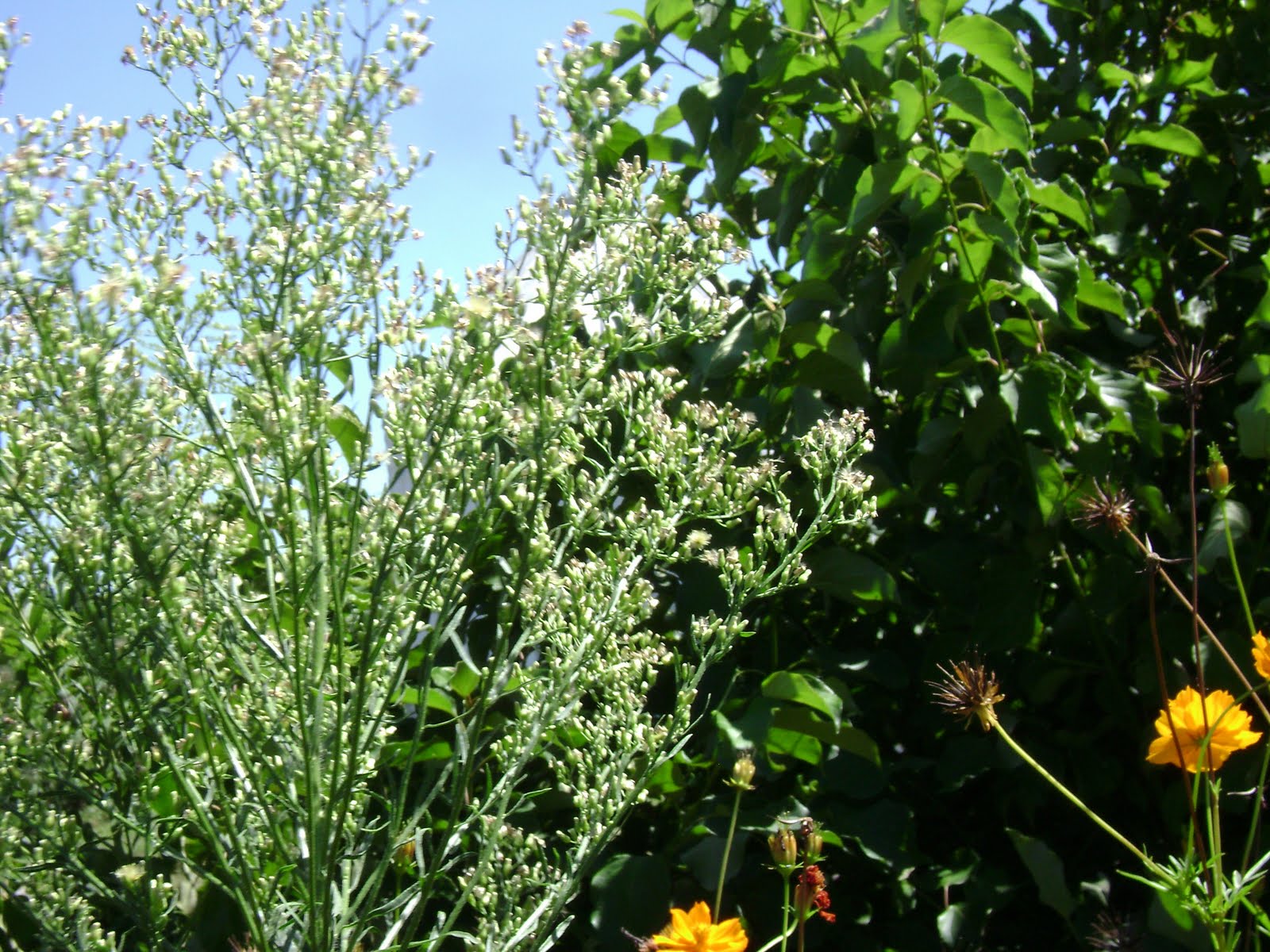
The first order of business was to start on the Butterfly Garden, which has turned into the Garden of Chaos this summer.  I was happy to see so many plants reseed themselves this spring, but it has meant my original careful plans for planting last year have been scrapped, and the volunteers have taken control of the garden.  To add to the chaos, I wasn't always able to identify seedlings.  Thus, flowers were inadvertently hoed out, and weeds were often allowed to stay.  The seedlings that grew taller and taller for the past few months found me scratching my head--were these weeds or could they be asters?  As it turns out, they were members of the aster family (what isn't??), but not desirable ones.  The tall plant at the left of the photo above towering over even the cosmos and Joe Pye weed is a horseweed, or as my Dad calls it, mare's tail.

Now the horseweed does have some rather pretty flowers, as you can see, but it is a weed after all, even if it is included in my Illinois Wildflowers book, so it must come down.  Armed with long-handled pruners--a machete would have been more useful--I tiptoed through the jungle of plants to cut each plant down.


Two down . . . oh, look at this little bee feasting on the cosmos blossom.  Let's just put the pruners down for a moment and grab the camera, conveniently tucked inside my pants pocket.


And what are these fluttering wings on the nearby Susans?  I think they might be Pearl Crescents, tiny little butterflies that I've never been able to photograph.  Be very still . . .


Ah, patience is rewarded.  Aren't these sweet?


I think he must like me after all, to stay so still.  And look, he even has a friend . . . or at least I hope that's a friend, not some predatory wasp.  Fly away, little Pearl!

Ok, back to the horseweed on the other side of the garden and some other unidentified weeds . . .


Still not sure if one weed-looking plant is an aster, but one mystery is solved.  Yes, this IS goldenrod, and it's blooming already!  I think this out-of-focus insect is a soldier beetle, often seen in my garden. Let's put the pruners down again for a moment and get some better pictures of the goldenrod.


Well, now that's a little better.  The bees obviously love this plant . . .


. . . as do the Sulphurs.  But then the Sulphurs seem to like every type of flower--there are literally clouds of them flying about every flowerbed I have.


Oh, but wait!  This little butterfly is not so common, and I've never gotten a photograph of it.  I'm not sure if it's the Eastern Blue, but it looks very much like it.  I wish I could get a better picture, but it just won't stay still and it is so tiny.


Wow, I didn't realize that goldenrod attracted so many creatures.  I'm not sure what either of these is, but the one on the left looks a lot like the cicada killer wasp pictured in my insect book.


Perhaps it is looking for this.  The cicadas are thick right now, their loud song providing a sort of buzzing lullaby each night.

I seem to have lost interest in weeding . . . maybe I'd better go water some of the containers before the sun dries them out again.


At least while I am watering, I can lock the hose into open position and put it down if I get distracted.  An orange butterfly has been eluding me for the past several minutes, flying away each time I put the hose down and get my camera.  I think it's a fritillary, but where did it go?  No, this isn't it--it's a butterfly I haven't seen before, and in fact, I have no idea what it is. Hmm, interesting. 


Put the camera away, Rose, and finish up the watering, for heaven's sake.  At least the porch planter won't be so distracting; the butterflies don't seem to like its shady environs as well.  Oh, but look at this cute little hoverfly burrowing into the petunia blossom. 


"Hey, aren't I pretty enough for one of your pictures?"

"Well, of course, you are, Mr. Mantis!  You know you're one of my favorite subjects, especially since you sit still so nicely for all photos."

Ok, the watering is done.  Time to get back to those weeds in the Butterfly Garden . . .


Oh, but I have to take just one little photo of this swallowtail on the orange cosmos!  I've been bragging about what great pollinator magnets these cosmos are, and what better example could there be than this.  Please, Ms. Swallowtail, could you move just a little to your right?


Better . . . but I still can't see your face . . .


Ah, perfect!  Thank you so much!

Ok, the perfect photo has been taken; now it's time to get back to weeding.  But wait, it's lunchtime already, and then I might just have to take a little afternoon nap after working so hard all morning.  

I just don't understand why I don't seem to get much done in the garden:)


Sending wishes for a Happy 85th Birthday to my Dad today!