.JPG) |
| There is a driveway there somewhere. |
Looking back through my posts this winter, I noticed I never wrote my usual post on the first snowfall. There is a good reason for that: most of the winter the big snowstorms have passed either to the north or south of us, leaving us with only a few inches of snow at the most. That is, until the past weekend. Apparently, Old Man Winter decided we shouldn't feel left out and dumped at least 10 inches of snow here this weekend. On March 1, for pete's sake, the beginning of meteorological spring! Oh well, there's nothing I can do about it, and since I can't get in the garden, it's a good time to join in for another meeting of the Book Review Club. This month's recommendation for an excellent book: All The Light We Cannot See by Anthony Doerr.

Flashback 10 years: The LeBlanc family is cursed, neighbors say, when young Marie-Laure goes blind due to a congenital condition. Her life becomes one of frustration as her bed with the quilt pulled up to her chin becomes her only refuge.
The despair doesn't last. Marie-Laure is too young and her father is too patient. There are, he assures her, no such things as curses. There is luck, maybe, bad or good. A slight inclination of each day toward success or failure. But no curses.
Her father helps her to learn Braille, and every evening he works on a miniature scale model of their neighborhood in Paris. Days are spent at the National Museum of Natural History, where Marie-Laure's father is principal locksmith. He takes her on his rounds, quizzing her on objects, and in the afternoon he leaves her in the laboratory of an old mollusk expert where Marie is allowed to touch thousands of seashells and learns to identify each by its weight, texture, and curves.
Marie-Laure is an inquisitive child, and her father is determined to help her achieve independence. When the model of the neighborhood is finished, he asks her to memorize every home, shop, and intersection, then takes her on walks until she can navigate the streets by herself. The bond between these two is strong, and they live a happy life until the German army approaches Paris, and they must flee to safety at the home of Monsieur LeBlanc's uncle in Saint-Malo. There Marie learns to travel through a new neighborhood once again and wins the trust of strange Uncle Etienne. As the war comes closer and closer, they find themselves playing a role in the French Resistance.
.JPG) |
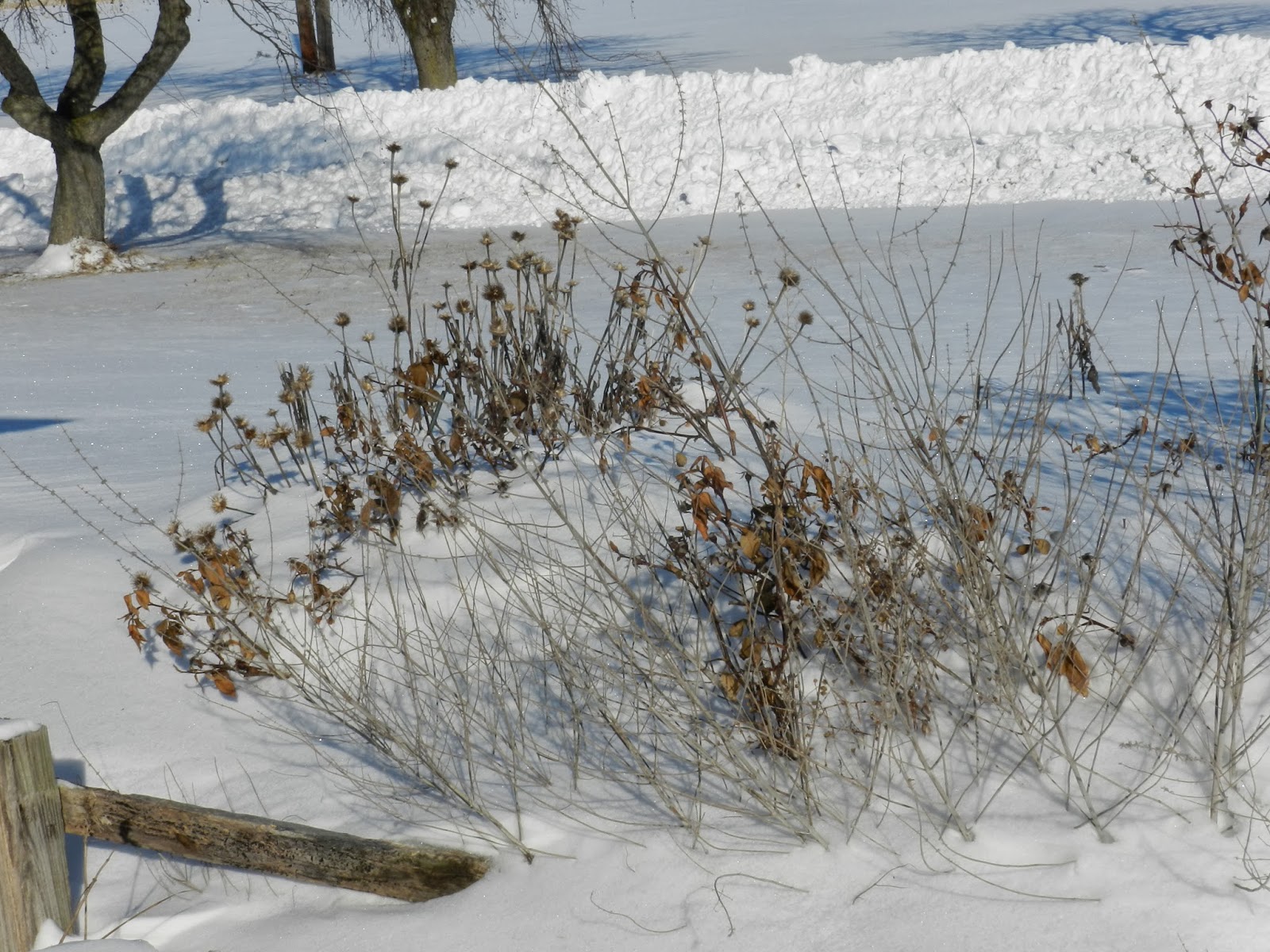
| Coneflowers stand as sentinels in the garden. |
Three hundred miles to the east, young Werner Pfennig grows up in Zollverein, a coal-mining complex outside of Essen, Germany, where the sky is permanently gray, and the landscape is covered with the fine black soot of coal. He lives in an orphanage where food is hard to come by, and he and his sister Jutta often spend their days scavenging for scraps of food and small "treasures." One day they find a discarded broken radio, and they take it home where Werner studies it and studies it until he figures out a way to fix it. The sudden sound of music coming across the airwaves is a miracle, and soon evenings are spent listening to broadcasts from far-off places.

Werner's reputation as a genius with radios grows, and soon townspeople bring him their broken radios to be fixed. Then a Nazi captain asks him to his home to fix the most magnificent radio Werner has ever seen, and when the radio is repaired, the captain recognizes that Werner is something special and recommends that he be selected to attend a school for exceptional boys where he will learn the latest in science. Werner is apprehensive about leaving his home and his sister, but at the same time excited to escape his certain fate in the coal mines, the place that claimed the life of his father. However, the school is actually a training ground where young boys are molded into future Nazi soldiers. Young Werner sees the cruelty in the training methods of the instructors and tries to protect his sensitive friend Frederick. But in the end he realizes that he has no choice but to follow directives if he is to survive.
.JPG) |
| Icy Clematis |
How and when will these two very different characters meet? The novel alternates between the stories of Marie-Laure and Werner and begins with the scenes in 1944 where they are both trapped in Saint-Malo, so you know that it is inevitable their paths will cross at some point. Waiting for their stories to intersect kept me reading as I wondered what that meeting would be like.
 |
| Not little ghosts, but a line of shrubs blanketed in snow. |
Over a year ago, I vowed I would not read another book set in Nazi Germany for a long time--the events and atrocities during this time period are just too depressing for me. But my book club chose this book for our last meeting, so I didn't have much choice, but once I began reading Doerr's beautifully written prose, I was glad I had decided to participate. The book certainly has some sad scenes and a one particularly cruel character, but does not include graphic violence, fortunately. Some reviewers have called it "surprisingly uplifting," and I agree that is the best way to describe its message.

It is the characters once again, however, who make this book so appealing. One can't help but admire the curious and optimistic Marie-Laure who overcomes her handicap to "see" what others cannot. Her enthusiasm for knowledge is infectious, and she changes others for the better. Werner is also a likeable character, but mostly one feels sorry for him as he is forced into circumstances over which he has no control. As his comrade Volkheimer says, "what you could be." In another time and another place, Werner could have become a brilliant scientist. But he does find a way to defy authority and finally follow his morals as he remembers that long-ago voice on the radio:
" Open your eyes," the Frenchman on the radio used to say, "and see what you can with them before they close forever.'"

This is a story of survival and the resiliency of the human spirit and of unlikely heroes who remind us that even in the worst of times there is goodness to be found and people who will rise above to do what is right.

Click icon for more
book review blogs
@Barrie Summy