Saturday, August 8, 2015

Big Ideas in Small Spaces: Garden Walk 2015

In June, our local Master Gardeners group held their annual Garden Walk.  This is the only fundraiser held each year to support the the group, and planning begins a year in advance to make sure it continues to be the popular and successful event it always is.  This year's theme was "Scents and Sensibility," with a focus on gardens that use sustainable practices.  But what I also noticed this year was that the committee had chosen more smaller gardens than usual, and that turned out to be a wise decision based on all the positive comments I heard from those attending.


The Garden Walk requires hundreds of volunteers in order to be successful, and I volunteered for my usual morning shift--to avoid standing during the heat of the day.  The garden I was assigned to was in an older neighborhood with standard 1/4 acre lots.  But this relatively small space was a showcase for using found objects as garden art.


The owner half-jokingly told me that when her neighbors want to throw something out, they just toss it over her fence, and she paints or re-purposes it in some other way and finds a place for it in her garden.  When her neighbors see how she cleverly uses their "junk," they sometimes ask for it back--but she said she has refused to return anything so far:)


Now this is a real "window" box!


Probably the piece that attracted the most attention in her garden was this new potting shed she built.  Located at the back of her house, it is built completely out of old doors with a piece of corrugated tin she salvaged as extra protection on the roof.


Not far away, in an even older neighborhood with modest homes, was the next stop on the Walk, a delight for any no-lawn enthusiasts.  I wish I had taken a better photo, but the front "yard" was completely devoid of grass and filled with hostas and other shade-loving plants.  Gravel paths meandering through the beds invited visitors to slow down and explore.


The back yard was another oasis of greenery with nary a blade of grass to be found. More gravel paths allowed visitors to roam and see every part of the garden.


A small pond surrounded by a variety of plants provided the soothing sound of water.


Fairy gardens are the ultimate in small gardens.  I loved the use of the two old wagons here to create a virtual fairy paradise.


This garden was such a shady retreat, I could see myself sitting in these red chairs every evening.  Who needs acres of woodland when this small backyard provided such a peaceful and beautiful place to relax and enjoy nature?


Our next stop was in the heart of town, not exactly a place where you would expect to hear the sound of chickens. In fact, only recently has the town of Champaign allowed residents to keep chickens, so I imagine this was an educational experience for many visitors on the Walk.


This little lady seemed quite eager to pose for the camera, or maybe she was just curious about all the strangers passing through her garden.


Besides the chickens, the big draw of this home was its vegetable garden.  Normally, I am prefer touring flower gardens, but the carefully maintained raised beds and trellises provided so many great ideas about how to improve my own tiny vegetable garden.  This garden fit the Walk's theme of sustainability so well as the owners incorporate environmentally-friendly practices and enjoy feeding their family what they have grown.  I think many "city-dwellers" went away inspired, seeing what can be done on an ordinary city lot.


The most interesting part of this garden for me was the hugelkultur bed by the street corner.  I wasn't familiar with this term, but very simply, a hugelkultur bed is one that is built using rotting wood as its base.


It is situated at the street corner for a reason, as you can see by this sign.  The owners are not only educating visitors, but they are sharing their bounty with their neighbors as well.


And in case a curious passerby isn't quite sure if that tomato or pepper is quite ready for picking, they provide instructions as well.  I just loved this idea!


Not all of the homes on the Garden Walk were in older neighborhoods with smaller homes, however.  In one wooded subdivision, the owners learned how to work with nature to develop their garden when they purchased the house.  The front yard, where grass struggled to survive under dense shade, has been gradually replaced by groundcovers and woodland plants.  Here, by the front walk, a small shade garden demonstrates a great example of mixing colors, textures, and shapes.


A large sunny border in the back yard is filled with hardy perennials that can withstand harsh Midwest winters and the strong winds that often sweep across the open fields nearby.  "No tender babies allowed!" says the homeowner.


Another home in one of the "ritziest" subdivisions in C-U featured an absolutely beautiful garden!  Why I didn't take more photos of this garden, I don't know.  Partly it was because it was the last one we visited and it was getting late.  As much as I enjoyed the diverse plantings, the dry streams, and all the different water features, I couldn't help turning to my friend and smugly whispering, "They don't maintain this garden themselves."  Indeed, they do have a regular landscaping maintenance service, but I later met the homeowners and discovered that they are in fact knowledgeable gardeners and do work in the gardens themselves.  My apologies for being so quick to judge, but still...I'd like to have a crew of strong backs to come in and help me, too:)


A garden in another upscale subdivision was a different story, however.  The front garden was lovely, with pots and striking art pieces echoing the colors of this contemporary home.


A repurposed cart in my favorite shade of turquoise added a pop of color in another front area, but still well within any homeowners' association guidelines.


In back, a small pond and more shady plantings created a pleasant backyard retreat.


But beyond these conventional garden areas, we found quite a surprise--a large butterfly garden filled with pollinator-friendly plants.


Nearby was another area filled with even more natives and areas created to attract all kinds of bees.  Notice the sign which explains the significant role of native solitary bees and the importance of creating habitats for them.


A nesting house illustrated one way of providing for these important pollinators.

On the other side of the house (no photos) I was also surprised to find a large vegetable garden contained within several raised beds with some of the biggest tomato plants I'd ever seen in June.


This had to be one of my favorite gardens on the walk just because I wasn't expecting to find this in such a setting.  I thought it was ironic to look across the lake and see golfers at the country club putting away on their carefully manicured and heavily fertilized grass, totally unaware of the beautiful, natural setting just beyond.

During my morning shift as a garden guide, several visitors remarked to me how much they enjoyed this year's gardens, especially the smaller ones because they seemed more "do-able."  Like them, I enjoy visiting public gardens and large private gardens.  But such big gardens can seem a bit intimidating, and often any ideas I come away with are plants I'd like to have or small vignettes that I might be able to copy.  Small gardens like those on this year's garden walk, however, inspire anyone that no matter how small the space or how limited the time or energy one has, anyone can have a beautiful garden!

Wednesday, July 15, 2015

July Bloom Day

It's the middle of July already--or as we are beginning to call it, "Monsoon Season"--and time for another Garden Bloggers' Bloom Day.  Between all the rainy days and being busy with family activities, I haven't had time to do any work in the garden lately.  But I do take a little stroll each day, admiring all the blooms and ignoring the weeds and anything else that needs to be done.


It is Lilypalooza time, with nearly every daylily blooming right now, creating a riot of color throughout the garden.  I tried to use the collage tool on the simple photo editing program that came with my computer; it didn't produce quite the effect I was looking for, but it gives you an idea of some of the various blooms that I am enjoying at the moment.


I won't take time to show every single lily that is blooming, but I want to share a few of my favorites, including this spider lily whose name I've forgotten.  I don't remember it blooming last year and was afraid I'd lost it, so I'm especially glad to see it reappear this year, looking healthier than ever.


Another nameless favorite is this passalong from friend Beckie.  This dark beauty has very large blooms and a throat that positively glows in the sunlight.


The fair 'Juliet' and her love 'Romeo Lies Bleeding' have been blooming for several weeks--I love happy endings:)


All of the lilies I have purchased were carefully tagged and their names recorded in a garden journal . . . somewhere.  But as they grow larger and the tags disappear who knows where, it becomes more difficult to remember who is who.  I think this might be one of my first lilies, 'Orange Tangerine Ruffle.'


A new daylily I planted late last summer to add to my growing "literary" collection, 'Tennyson' is quickly becoming a favorite.


I purchased five new daylilies last summer and carefully tagged each one.  But over the winter, the tags disappeared on a couple of them.  I thought I could figure out which lily was which by the process of elimination, but I've discovered instead of five new lilies, I have six!  Although I remember five names, I have no recollection of where the mystery sixth one came from.  Consequently, I'm not sure if this is 'Susan Weber'....


. . . or is this 'Susan Weber'??  By the way, 'Susan' is named after a local MG who is a daylily enthusiast.  A plant breeder met her and named one of his new hybrids after her--how cool is that?!


Besides the daylilies, the Oriental lilies are beginning to bloom as well. My daughter's favorite, 'Stargazer,' opened up the day she and her family arrived for a visit.


Another whose name is lost in my disorganized files is Salmon something...


I haven't had time to deadhead anything lately, but this little visitor seemed to appreciate the faded lily bloom for a brief resting spot.  Maybe I'll just forget deadheading altogether:)


Of course, there is so much more blooming right now than lilies.  The red, pink, and nearly blue phlox are fading, but the white 'David' is just coming into his own.  All this rain, however, is producing some less than attractive blooms.


I thought the portulaca in the birdbath planter would not appreciate the rain either, but it is blooming its head off anyway.


The hydrangeas are loving all the moisture, though.  'Vanilla Strawberry' keeps getting bigger and bigger each year and is covered in blooms.  This is a special plant, one given to me by my friend Cheryl  from the UK when she and her husband visited here a few years ago. I'll always treasure this hydrangea as a reminder of our blogging friendship and the memories of that visit.


The blooms eventually gain a pinkish cast, but right now they are more 'Vanilla' than 'Strawberry.'


Moving along to the shade garden, I was surprised to see a few columbines re-blooming.


A few of the Caladium bulbs I planted have also appeared.  And yes, those are plastic forks surrounding the plant--so far they seem to have deterred the voracious rabbits that are proliferating like crazy this year.  Actually, I'm not sure if it's the forks or the fox that has been visiting our property recently, but I'm glad these have escaped bunny damage so far.


The hostas are blooming as well.  I know not everyone likes the blooms on hostas, but I do.


And I'm not the only one--not the best picture, but you might notice the bumblebee to the center right of this photo.  As I was walking around the shade garden, the bumbles were happily flying from one hosta bloom to another, enjoying whatever delights lay within.


A couple other blooms here and there--I showed this Rudbeckia hirta blooming in the roadside garden on my last post.  It's 'Prairie Sun,' which I have grown from seed the past few years.  I treat it  as an annual, though it is actually a short-lived perennial hardy from zones 3-8.  But this year it has self-seeded in several places, much to my delight.  I have other Black-eyed Susans, but I especially love these Green-eyed Susans!


More yellow blooms in the butterfly garden--Ratibida pannata, gray-headed coneflower  is a native that stands out among the yet-to-bloom asters and goldenrod.


Of course, I couldn't complete a Bloom Day post without showing the coneflowers once again.  It's an understatement to say they are swarming with butterflies on a sunny day, the air is so thick with them.


And other creatures enjoy them as well.  Yes, if I could have only one plant in my garden, it would have to be coneflowers.  


As I mentioned at the beginning of this post, I've been very busy with family affairs lately.  My mother, unfortunately, is back in the nursing home.  On a happier note, my daughter and son-in-law came for a visit last week, bringing my youngest grandson for his baptism and his first visit to Grandma's house.  He's definitely the best bloom in my garden!


For more GBBD posts, you can visit Carol at May Dreams Gardens.

Thursday, July 2, 2015

Goodbye June: A Summer Stroll Through My Garden

There are two words to describe the month of June this year---wet and wetter.  In fact, it's now official that this has been the wettest June on record.  All the rain has meant it has been difficult to get out into the garden often enough to pull all the weeds that are thriving, let alone finish putting the mulch down.  On the bright side, though, the plants are loving it, and I haven't had to water at all other than a few containers sitting under the eaves.

I realized this week that in spite of the weeds and unfinished chores, this is the perfect time to visit my garden.  The coneflowers are in full bloom everywhere, and the lilies are all opening up, making this the most colorful time of the year.  So how about a little stroll through my garden?  For once, I'm going to show mostly long shots instead of my usual close-ups, as long as you promise to ignore the weeds and the random hoses or junk tools or mulch that I couldn't crop out of the picture.  My garden isn't that large, but it is spread out, so if you were here, you'd need some walking shoes.  Instead, grab another cup of coffee and join me as I give you a little history of the garden.


When we moved to this house in the late summer of 2004, we inherited a large yard with many beautiful trees.  But there was nothing else here, other than some overgrown yews on the north side of the house.  That fall I moved a few of the plants I wanted to keep from the old house and plopped them into a shady spot under the big evergreen at the corner of the house.  I wasn't much of a gardener then, so I'm surprised they survived, but they did.  Little did I know at the time that that would be just the beginning of a new obsession.   The front of the house looked so plain, so several years later I added the shrubs along the front side, too.


When I retired a few years later, I expanded the shade garden, doubling its size.  By that time I was becoming a plant addict, so of course, I had to add more plants, resulting in the green jungle where ever-growing hostas threaten to take over smaller plants.


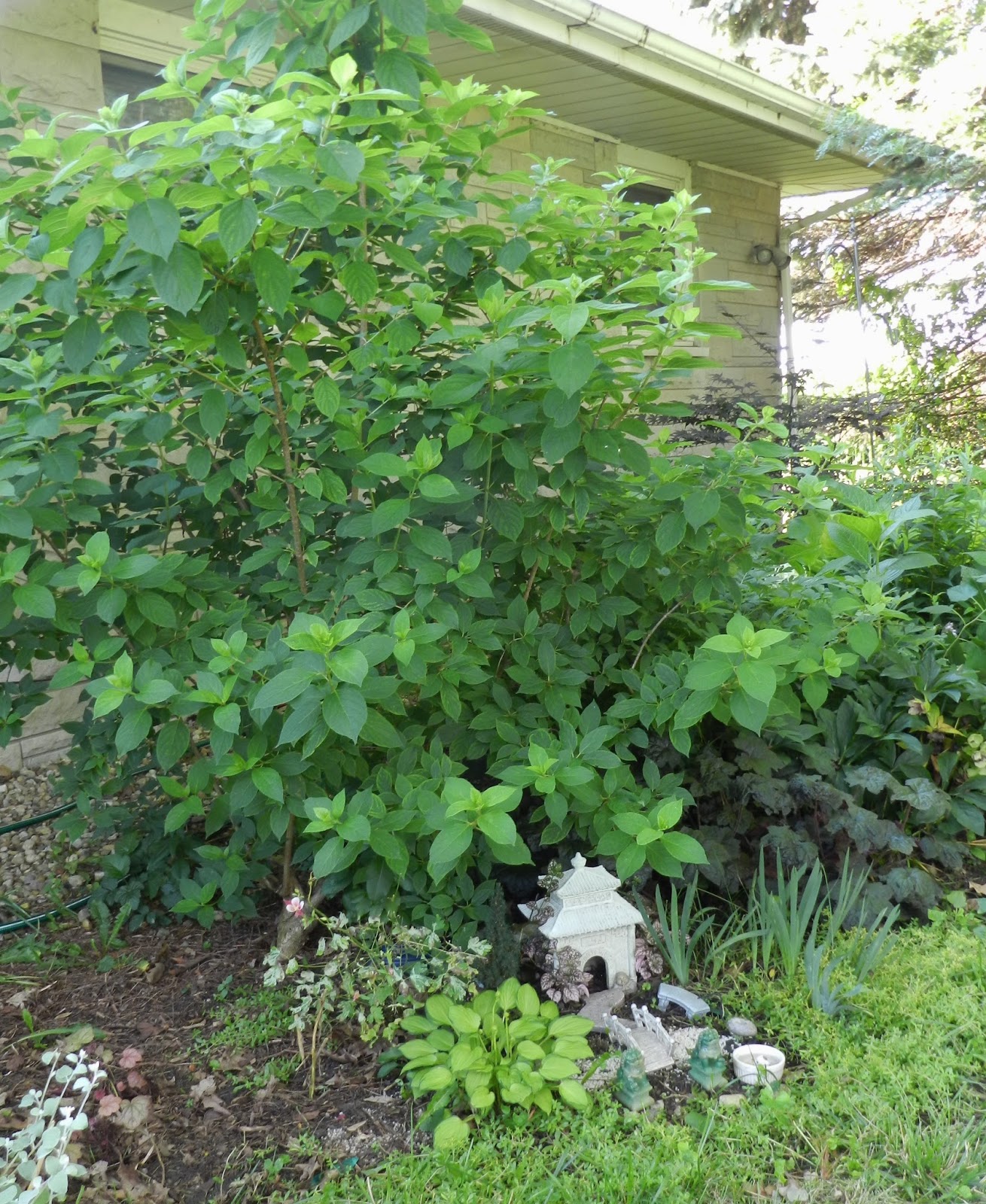
On one side, the shade garden is bordered by a 'Limelight' hydrangea with the miniature Japanese garden nestled underneath.  Looking back at my post on this little garden from two years ago, I'm amazed at how much the 'Limelight' has grown. I've been trying to get it to become more of a tree shape and prune a few branches each spring, but darn, it's hard cutting back much when I see all those gorgeous flowers every August.


The other side of the shade garden is bordered by a very tall evergreen, which I still haven't identified. The area underneath its low-hanging branches tends to get very weedy, and I've pretty much ignored it until the last year or two.  But this year I cut back as many of the weeds as possible and mulched most of the area with a thick layer of leaves.  I've also planted various groundcovers, hoping one day they'll take over the area and choke out the weeds.  The tower planter, by the way, was made by my daughter's boyfriend and a birthday gift last year--it's not so easy to grow things vertically, I've found:)


I've been trying to add more height to the back of the shade garden, but it's taking awhile.  The bargain Japanese maple on the left has taken a growth spurt, though, and finally can be seen above the giant 'Sum and Substance' hosta.


From my first garden area to my newest--I had been wanting to expand the shade garden even further for a long time. Last year I noticed the lawnmower tracks around this nearby oak tree, and a light bulb went off.  I convinced my non-gardening-you-have-more-garden-than-you-can-take-care-of husband that if I planted all this area, it would be so much easier for him to mow around the tree. The logic worked!   I quickly got busy, covering the area with newspapers and compost and began digging up hostas from the shade garden to move here.  It's amazing how quickly I could fill an area just with divisions from my own garden, but of course, I couldn't resist buying even more shade-loving plants now that I had more room.


I've learned some valuable lessons over the past few years as I've evolved into a gardener.  One of the most important is not to plant things too close together, so this area still looks rather bare to me, but I think I'll be happier in another year or two.  I also have been better about getting this area mulched right away.  The tall, spiky plants, by the way, are some of the 80 daffodils I planted in this area last fall whose foliage just will not die back, it seems.  Oh yes, and Sasha is only temporary garden art:)


Back to the chronological tour . . . the first full summer we lived here, I decided to turn this triangular area into a flower garden.  At one time I think there were some small shrubs and flowers here (my in-laws built this house and lived here until they passed away), but the house had sat vacant for several years, and nothing remained here but some very overgrown yews at the back and layers and layers of gravel.  I've told the story of digging out all that gravel before, so I won't repeat it here, but let's just say it was a challenging experience that took me most of the summer.  The area has changed over the past 10 years, most notably the absence of the big yews which we cut back, and which I was told would grow back, but didn't.  But that's a story for another day.  I keep intending to revamp this whole garden and started the process this May until my mother became ill.  She's doing better, I'm happy to say, but it's too late to make any major changes to the sidewalk garden now--another project for next year.


One of the things you'll notice in the previous photo is that the coneflowers have taken over this area.  I pulled many of them at the front of the border this spring and intended to take out more before I got interrupted by family obligations, but once they began to bloom....well, who would have the heart to pull these out??


I do love coneflowers; I just would like to have more variety in this small area.  But they are butterfly and pollinator magnets.  If you look closely, you'll see there are at least five Red Admirals in this photo.  I counted another dozen on the rest of the flowers this day before I lost count.  


The large boulder in place at corner of the driveway also begged for some color, so I added some of the 'Stella d'Oro' lilies I had also brought with me.  In the spring, daffodils and tulips bloom here as well.


That same year our beloved big dog Roco passed away, and I created a little garden memorial for him.  It's a challenge keeping the weeds out of this area, especially all the creeping charlie that wants to invade the space.  I often talk to Roco while I'm weeding, reminiscing about all the good times we had.   He has since been joined by daughter's cat Max and granddaughter's first guinea pig.


Now let's take a little hike down our long lane to what I call my roadside garden which I planted the following year, in 2006.  It's really just a narrow flowerbed in front of three large burning bushes. The daylilies at the front--mostly 'Stellas'--are finishing up blooming while the coneflowers are just beginning.  Behind the coneflowers are some of my favorite daylilies, which you can't see from here, that should open up any day now.


One of my favorite flowers in this garden at the moment are these 'Prairie Sun' Rudbeckia.  I'll say more about these cheery flowers on Bloom Day.

Now let's head back up the lane to see the last few newer garden areas.


Once I retired, I had much more time to devote to gardening and discovered how much I loved it.  I dug up a small area out back to attract more butterflies.  In recent years it has become pretty wild, overrun with asters and goldenrod, but there are some blooms that stand out from their foliage right now, like this beebalm.


Butterfly weed's orange blooms show up through the foliage quite noticeably.  I just hope all the rain this year doesn't prove too much for them as it did for the large butterfly weed I used to have in the roadside garden.


A new addition this year is this Ascelpias curassavica, a tropical milkweed.  It's an annual here, but I love its vibrant colors and plan to grow it each year from now on.


Over the years I've learned more about the benefits of native plants and have added more of them to this area in particular.  I've also learned you have to be patient for some of these to grow, but it's worth the wait to finally see blooms like these just beginning on the gray-headed coneflower.


Nearer the driveway is one of the flowerbeds I created after retiring, the Lily Bed.  This is the area that really stands out right now, though it's hard to get a decent long shot of it.  I have become addicted to daylilies, and I've packed so many of them into this narrow space that I've run out of room.


Although this area was meant to show off my growing collection of daylilies, there are other plants, of course, too, that vie for attention like this bright phlox and the 'Vanilla Strawberry' hydrangea behind the NOID daylilies.


Over the years my garden has grown, but not enough to keep up with my ever-growing desire to have more plants.  Still, the lack of room doesn't stop me from adding more beauties like this one!


Finally, the next-to-newest garden area and the largest  is the Arbor Bed.  In the spring the front of this garden is filled with daffodils and tulips of every color.  Right now it's just beginning to acquire its summer color with more lilies and phlox as well as annuals beginning to bloom.


And of course, there are more coneflowers!  This area was carefully planned in the beginning, but as usual with all my plantings, this garden seems to have a mind of its own, too.  Besides all the plants I plopped here because I didn't know where else to put them, many, like the coneflowers, have re-seeded and taken up residence here.  Sometimes I pull them, sometimes not.


One of the plants here that is definitely a keeper, however, is my Amsonia Hubrichtii.  Although it's no longer blooming, its foliage looks beautiful all year whether surrounded by the last of the red poppies or Japanese anemones in the fall.

Thanks for taking the time to stroll through my garden with me.  Since these photos were taken, I've had a couple garden helpers help me do some more weeding and finally finish the mulching, so the garden is looking even better (including the small vegetable garden, which we didn't see).  It's the perfect time to visit my garden, so do stop by if you're in the area!


Have a happy and safe Fourth of July, everyone!